BrokerChain: From Academic Papers to a Live Sharded Public Chain▍
sharded blockchain · academic testnet · built by HuangLab
An academic sharded-blockchain testnet built by the HuangLab research group (黄华威研究组) at Sun Yat-sen University — turning the protocol designs published at INFOCOM 2022 and IEEE ToN 2025 into a live chain that actually runs and produces blocks.
01 What is BrokerChain Testnet
BrokerChain was originally proposed in 2022 by the HuangLab research group as a sharded blockchain protocol, first published at INFOCOM 2022 (paper: BrokerChain: A Cross-Shard Blockchain Protocol for Account/Balance-based State Sharding) with over 300 citations within three years of publication. In March 2025, the extended version BrokerChain: A Blockchain Sharding Protocol by Exploiting Broker Accounts was published in IEEE/ACM Transactions on Networking (ToN), a top journal in computer networking.
In June 2025, the research group turned the theory into a truly running blockchain system and launched BrokerChain Testnet (academic), for which the group keeps serving as the technical support team. Fully aware of how hard it is to build a public-chain ecosystem, the team is piloting with a testnet first and will launch the BrokerChain mainnet in the future.
The testnet prioritizes supporting blockchain researchers in on-chain innovation, while also being open to Miners (consensus nodes), Developers (dApp builders), and general Users. For real-time updates, follow @0xBrokerChain on X (Twitter).
02 Four Participant Roles
In the BrokerChain ecosystem, anyone can become a researcher, miner, user (including stakers, market makers, etc.), or dApp developer:
Researcher
Innovate at the protocol layer with the open-source code, or explore cross-layer innovation on top of on-chain dApps. For protocol-level studies, we recommend the open-source BlockEmulator testbed, used by researchers in more than 100 countries and regions worldwide.
Miner
Join the Testnet to earn block rewards: no heavy compute needed — a lightweight device running the client can join a sharded consensus network, take part in consensus, and keep earning block rewards.
Developer
Build dApps by deploying smart contracts to the embedded EVM, which is compatible with Ethereum smart contracts. Deploy and invoke contracts with Remix or JavaScript (ethers).
User
Submit token-transfer transactions, invest in on-chain financial products, stake tokens in DeFi protocols, become a broker (i.e., market maker) to earn liquidity-staking income, claim faucet tokens, participate in airdrops, and more — all through BrokerChain Wallet.
03 Quick Start: Connect with MetaMask
BrokerChain Testnet uses the same public/private key generation algorithm as Ethereum. Import your private key into MetaMask and add a custom RPC network to query balances and send transactions:
| Parameter | Value |
|---|---|
| Network Name | BrokerChain |
| New RPC URL | http://dash.broker-chain.com:42515/ |
| Chain ID | 1051 |
| Currency Symbol | BKC |
| Block Explorer URL | https://dash.broker-chain.com/ |
- Guangzhou Upgrade (2026-01-19): added MetaMask support and aligned the account system with Ethereum-compatible cryptography, so users and developers can manage BKC and deploy contracts via MetaMask.
- 7.30 Upgrade (2026-07-30): completed Ethereum-standard RPC interfaces and optimized the gas fee system; Gas Price and Gas Limit can be customized when sending transactions.
- Full JSON-RPC API reference: BrokerChain JSON-RPC API documentation.
04 Faucet & Wallet: Claim BKC
- Standard faucet: the Faucet button built into BrokerChain Wallet lets you claim a small amount of BKC for free — handy for experiments, tests, or as “seed funds” for running a miner client. Each account is limited to a few claims per day.
- Developer faucet: to support developers building dApps on BrokerChain, the Dashboard provides a Faucet for developers — submit an application explaining your purpose and contact details (e.g., email and the account address to receive the tokens) to claim a larger amount of BKC for development and testing.
- Daily check-in: keep BrokerChain Wallet running on your phone and the account automatically receives 1 BKC per day (only once per day even if multiple accounts are imported).
Download BrokerChain Wallet: github.com/HuangLab-SYSU/brokerwallet-academic/releases (Android for now; an iOS version is planned).
The Dashboard (https://dash.broker-chain.com/) also lets you check the number of tokens minted in recent hours and query account balances by address.
05 Run a Miner (Consensus Node)
- Download the client: pick the client for your OS (Windows / macOS / Linux) from the BrokerChain GitHub Release page.
- Entry threshold for new accounts: a new account must hold at least 2 BKC before joining the consensus network (a stake threshold against Sybil attacks); claim them from the faucet first.
- Form a shard and start producing blocks: once admitted, the node waits to form a new shard committee with other nodes, then starts executing the consensus protocol and keeps earning block rewards. Accounts with sufficient balance can choose to join a Senior Shard or a Junior Shard.
- Notes: each private key can run only one miner client; “view change” messages are part of normal operation, so keep the client running; dropping out of a Senior Shard deducts the stake-threshold “ticket” fee, so keep your machine and network stable.
Tutorial video (Chinese): BrokerChain miner client — how to install it and join the consensus network? — youtu.be/ZREsqTG7L8Y
06 Developers: Deploy & Invoke Smart Contracts
The testnet embeds the Ethereum EVM as its smart-contract execution environment and is compatible with Ethereum smart contracts and the Solidity language.
- Deploy with Remix: open remix.ethereum.org, select “Custom External HTTP Provider” in Environment, and fill in the wallet RPC address obtained after launching the client; set Gas Limit to 600000 before clicking Deploy.
- Deploy with JavaScript: use the ethers library (
ethers.JsonRpcProvider) to connect to the node RPC and deploy/invoke contracts; Sections 4.4 and 4.5 of the whitepaper provide complete examples and ERC-20 invocation code. - Future capabilities: future mainnet versions will support pluggable compliance and customizable protocol-layer development; the next-generation BrokerVM (BVM) will stay Solidity-compatible and embed real-time smart-contract vulnerability detection to help developers assess code risk before going live.
07 On-chain dApp Ecosystem (Demos)
The research team has built several representative dApp demos on BrokerChain, all with reusable sample code that developers can build upon:
Full details are in Chapter 6 (“Representative dApp Demos”) of the whitepaper.
08 Technical Roadmap
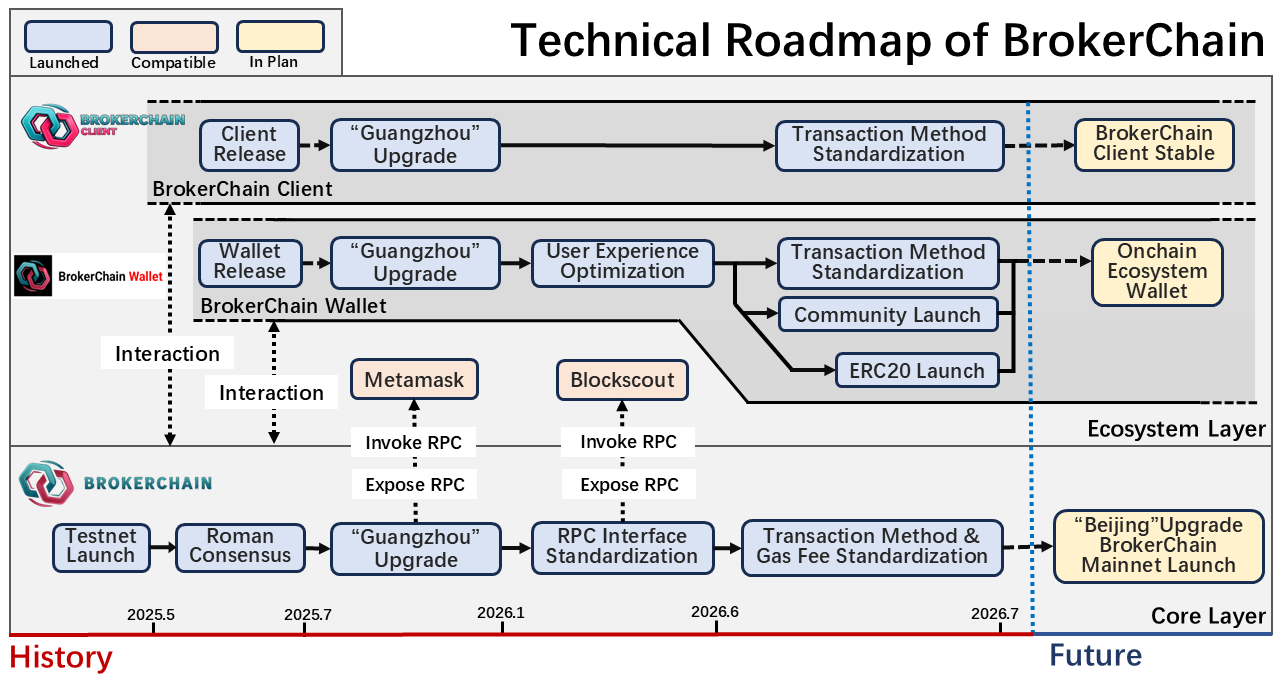
| Stage | Major progress |
|---|---|
| 2022 – 2024 | Protocol research: the BrokerChain sharding protocol and follow-up studies (Broker2Earn, Fine-tuned Account Migration, Justitia, etc.) selected for INFOCOM 2022/2024/2025 and WWW 2026 |
| 2025.06 | BrokerChain Testnet (academic) went live |
| 2026.01 | Guangzhou Upgrade: MetaMask support and Ethereum-compatible account system |
| 2026.07 | 7.30 Upgrade: Ethereum-standard RPC interfaces and gas fee optimization |
| Within 2027 | Beijing Upgrade: BrokerChain Mainnet launch (expected within 2027) |
| Future | Self-developed BVM (BrokerChain VM), next-level sharding consensus, and the next-generation high-performance sharded blockchain BrokerChain-NG |
09 What Makes BrokerChain Special
- Protocol-native: a native DeFi financial-protocol framework built into the chain, with flexible parameter adjustment, priority financial services, and customizable protocol-layer development (with controllable risk); pluggable compliance will be supported in future mainnet versions.
- Developer-friendly: Ethereum-compatible with customizable gas fees; representative dApp demos and sample code greatly lower the development barrier; real-time smart-contract vulnerability detection is coming.
- Consensus-friendly: join consensus and earn rewards without competing on computing power; lightweight user devices are supported; earned tokens can be staked into the chain’s built-in LP (liquidity-providing) pools for stable, low-risk liquidity-staking yields.
- Great user experience: the protocol keeps transaction confirmation latency low, making dApps smooth to use.
- Continuously evolving: a professional research team keeps upgrading the chain; the next generation of BrokerChain will support the self-developed BVM, on-chain AI, and real-time social-media applications that current chains cannot offer.
10 Risk Notice & Disclaimer
⚠ Academic use only: this testnet is for research, teaching, and academic exchange only; users must not engage in any illegal or for-profit activities.
⚠ Data reset risk: BrokerChain Testnet (academic) may restart due to technical failures or critical bugs; after a restart, the state data (or part of it) may be reset and some account information may be lost. Please be aware of this risk.
⚠ Others: any direct or indirect consequences arising from the use of BrokerChain are unrelated to the founding team; the founding team reserves the right to modify, update, or terminate the testnet at any time without prior notice.
11 Follow & Links
- BrokerChain on X (Twitter): x.com/0xBrokerChain
- BrokerChain Telegram channel: t.me/brokerchain0
- GitHub repository: github.com/HuangLab-SYSU/brokerchain-academic
- BrokerChain Wallet project: github.com/HuangLab-SYSU/brokerwallet-academic
- BrokerChain Dashboard (on-chain data board): dash.broker-chain.com
- Whitepaper download: BrokerChain Whitepaper & User Manual (June 14, 2026 edition)
BrokerChain Testnet (academic) is initiated and technically supported by the HuangLab research group (黄华威研究组) at Sun Yat-sen University. Welcome to join the testnet — researchers, miners, developers, and users alike — and explore the next-generation form of sharded blockchains.